Faifa (also transliterated Fayfa), Jazan Province, Kingdom of Saudi Arabia
الله يقبلكم عِداد خطاويكم وعِداد ما قد مشيتوا وعِداد ما أنتم ماشين
May Allah accept from you good deeds equal to the number of your steps — the steps you have already taken, and the steps you are yet to take.
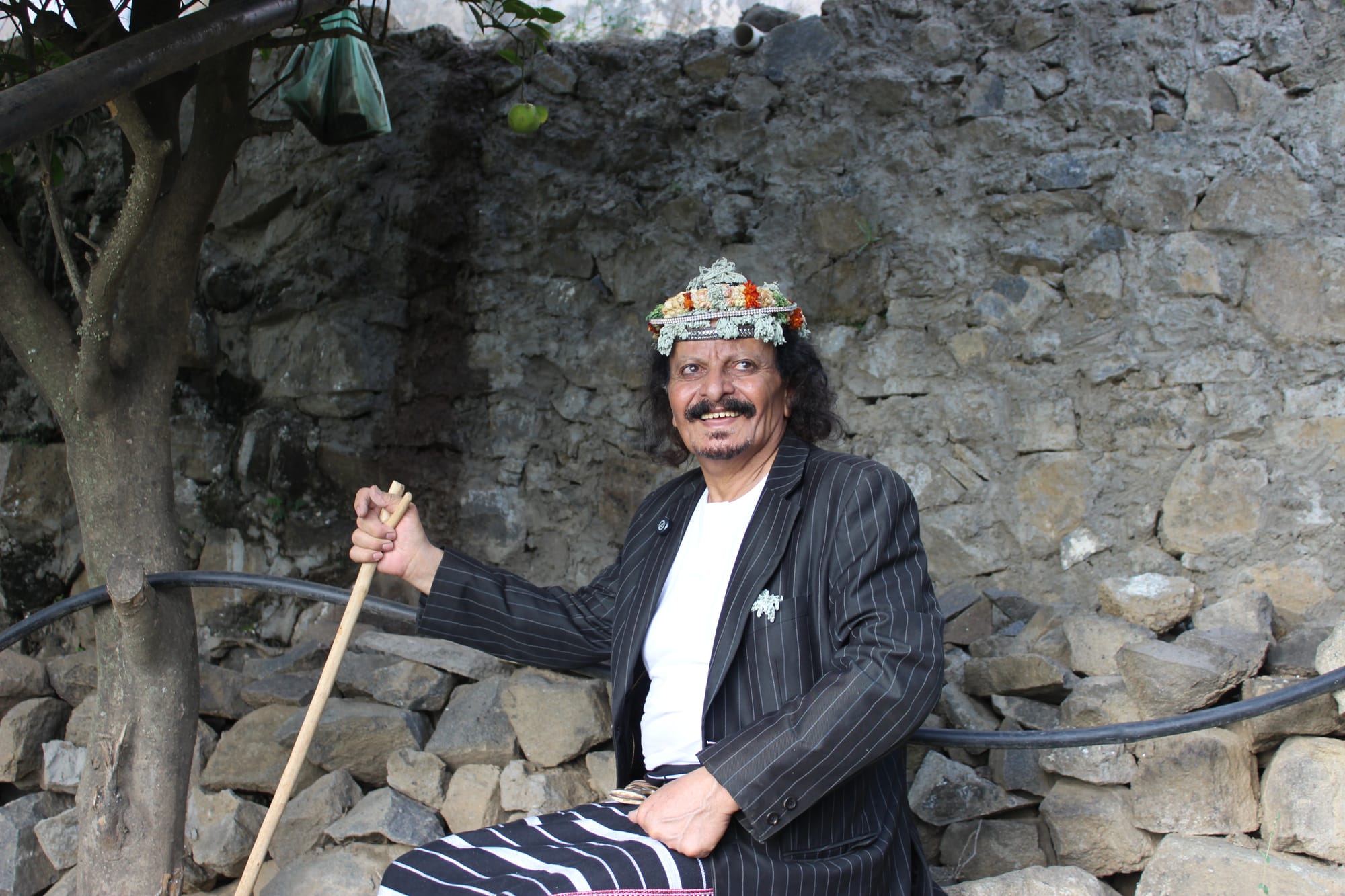
— Am Hussein bin Yahya Eidan Al-Sulumani Al-Faifi (Abu Sultan), welcoming us to his home on the mountaintop
High in the Sarawat range of southwest Saudi Arabia, a cluster of peaks wraps around itself so tightly that, from a distance, it reads as a single green pyramid rising out of the haze. Locals have given it a name reserved for very few places on earth: Jarat al-Qamar, the Neighbor of the Moon — sometimes also called the Heavens of the Earth, or simply the Hanging Gardens of Saudi Arabia, for the terraces that seem to float above the plain below. This is Faifa: a land of terraced slopes, stone villages, and a culture that has been carried, step by step, across centuries.
A Land Wrapped in Green
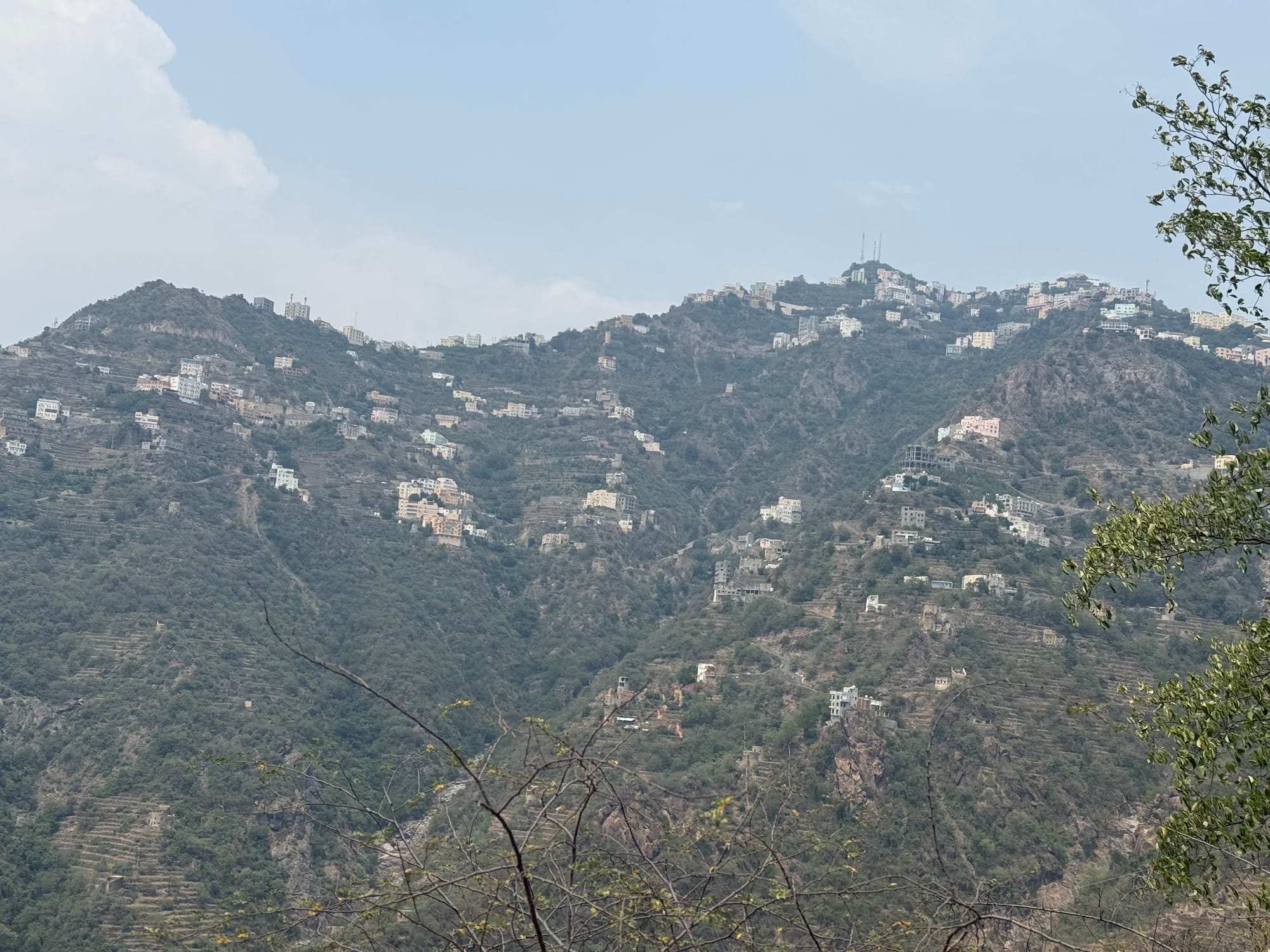
The Faifa Mountains sit roughly 100 kilometers east of the city of Jizan and some 60 kilometers from the shores of the Red Sea, forming part of the Al-Sarawat range that runs the length of southwestern Arabia. Spread across an area of nearly 600 square kilometers, they rise in a series of interlocking peaks — among them Al-Lagha, Al-Kadrah, Baqat Al-Washl, Al-Surrah, Qardah, and Al-Sama' — with the summit of Al-Absiyya standing highest of all, at an elevation of roughly 1,800 to 2,600 meters (about 6,000 to 8,500 feet) above sea level.
What sets Faifa apart from much of the surrounding landscape is its climate. While the coastal Tihama plain below swelters in heat and humidity, air currents rising off that same plain arrive at the mountain saturated with moisture, wrapping the peaks in fog and cloud and feeding the terraces that climb every slope. The result is a climate that stays mild and moderate for most of the year, with daytime temperatures typically settling between 19 and 29 degrees Celsius — a welcome coolness that turns still sharper on winter nights in the higher reaches, where the mountain earns its reputation as a highland retreat from the heat of the coast.
Episode 1: Faifa Museum, women's & men's attires
Terraces That Climb the Mountain: Agriculture and the Khawlani Harvest
Look up from the valley floor and Faifa's slopes appear layered, almost architectural — a staircase of hand-built terraces climbing toward the peaks. Cut into the rock and shored up with dry stone over many generations, these terraces are the reason the mountain supports life at all: they hold the soil in place, catch the fog and rain carried upward on the Tihama's moist air currents, and turn slopes too steep to farm into fields that can be worked by hand.
Among what grows on them, one crop has carried Faifa's name well beyond Jazan: Khawlani coffee, cultivated alongside maize on the mountain's terraced fields and counted among the most prized coffee varieties in Saudi Arabia. Growing it here is part of a much older Arabian relationship between coffee and hospitality — the same gahwa poured for a guest at any door in the Kingdom, grown just a short walk from Am Hussein's museum. It is this fertile, terraced land — as much as its height — that first drew outside chroniclers to ask how large Bilad Faifa truly was.
Episode 5: Am Hussien's farm and Faifa coffee beans
Bilad Faifa: A History Larger Than Its Borders
Before it was simply “the Faifa Mountains,” this region was known as Bilad Faifa — the Land of Faifa — a name that hints at a territory once far larger than what carries the name today. Muhammad bin Ismail Al-Kabsi, writing in 1308 AH (1890 CE) in his work The Splendid Subtleties Regarding the Chronicles of the Yemeni Kingdom, described it in terms that leave little doubt about its scale:
هي بلاد واسعة، مسيرة فوق عشرة أيام، جبال ووطاء [كذا].
It is a vast land, more than ten days’ journey across, of mountains and lowlands.” (Manuscript, p. 84)
Read closely, Al-Kabsi's account suggests that Faifa's mountains and the lands of Bani Malik were once spoken of as a single expanse — one “large land” rather than the more narrowly bounded Faifa recognized today. This account dates to the late 13th and early 14th centuries of the Hijri calendar, corresponding to the closing decades of the 19th century CE.
Sheikh Abdullah's Arabia: John Philby and the Chronicling of Jizan
John (Abdullah) Philby, 1885–1960 — full name Harry St John Bridger Philby, also known as Jack Philby or, after his conversion to Islam, Sheikh Abdullah — was a British Arabist, explorer, writer, and colonial intelligence officer who went on to serve as an adviser to King Abdulaziz ibn Saud, the founder of Saudi Arabia.
Philby is widely regarded as the foremost chronicler of Jizan's history in the 1350s AH. Traveling on assignment from King Abdulaziz — may God have mercy on him — he arrived in the region in 1355 AH, visiting Sabya, Faifa, and other districts as a guest of the Emir of Jizan, Muhammad bin Madhi. He witnessed Eid al-Fitr there, joined local dignitaries for the Eid feast at the Emir's palace, and went on to meet Jizan's prominent men and senior officials. His resulting book, Arabian Highlands, remains a historical reference on old Jizan, devoting a chapter of roughly twenty-five pages to the city's customs, houses, markets, port, and fortress.
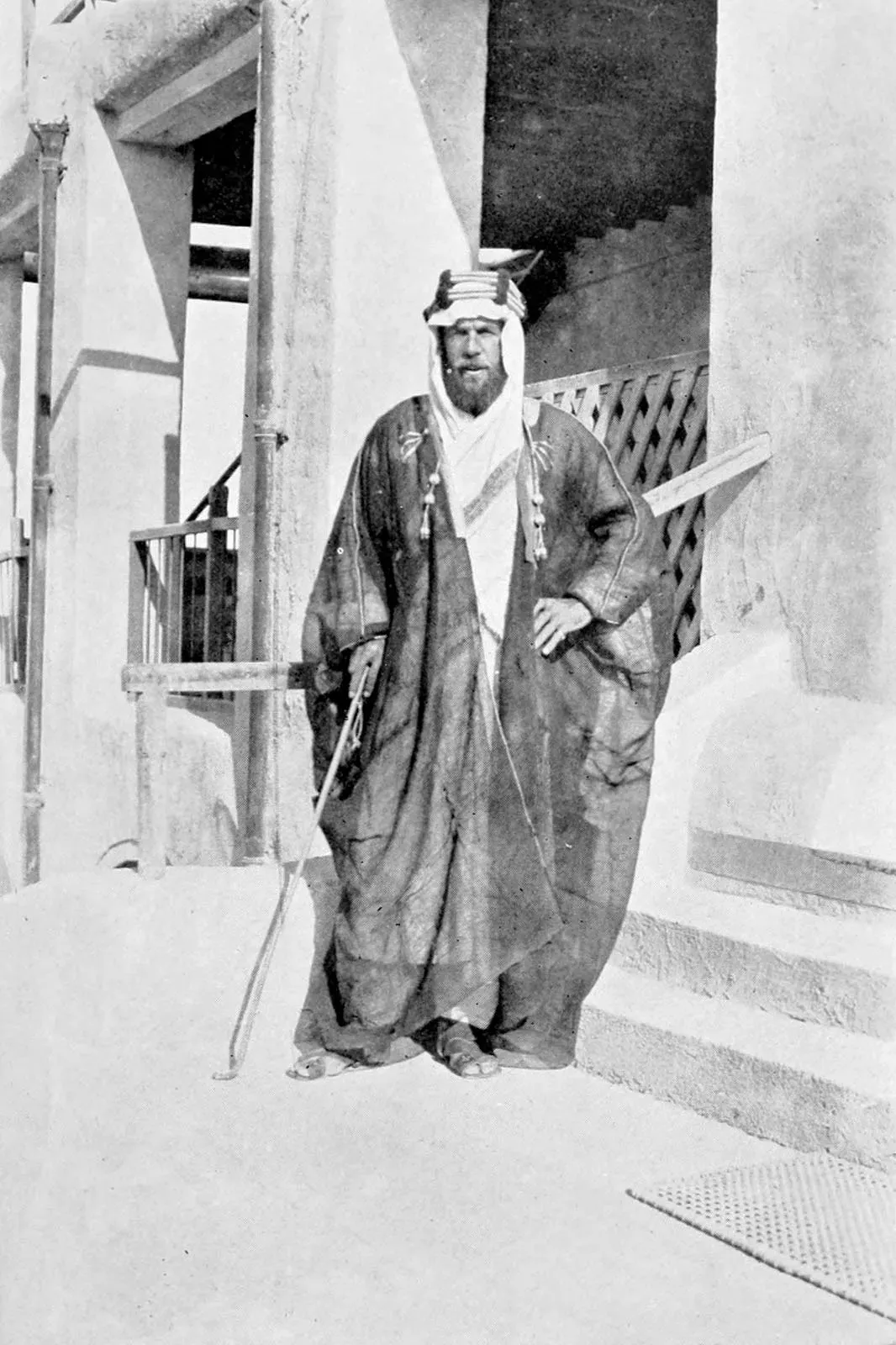
Of the women he encountered in Faifa's mountains, Philby wrote with evident admiration that “they were certainly good mountaineers and sound of limb and wind” — a nod to the strength and hardiness that mountain life demanded.
Am Hussein: Keeper of the Mountain's Memory
It was with the blessing quoted above that Am Hussein Al-Faifi welcomed us into his home at the top of the mountain. He leads Faifa's local traditional folklore band and is the founder and owner of the Faifa Museum — a role built over a 25-year career devoted to the culture and heritage of the region. We met him there, in a museum that looks out over Faifa's highlands, and sat together as he shared the customs, objects, and words that follow.
Episode 2: Faifa's dialect, traditional architecture & women's Mandil
Woven and Forged: The Language of Dress and Adornment
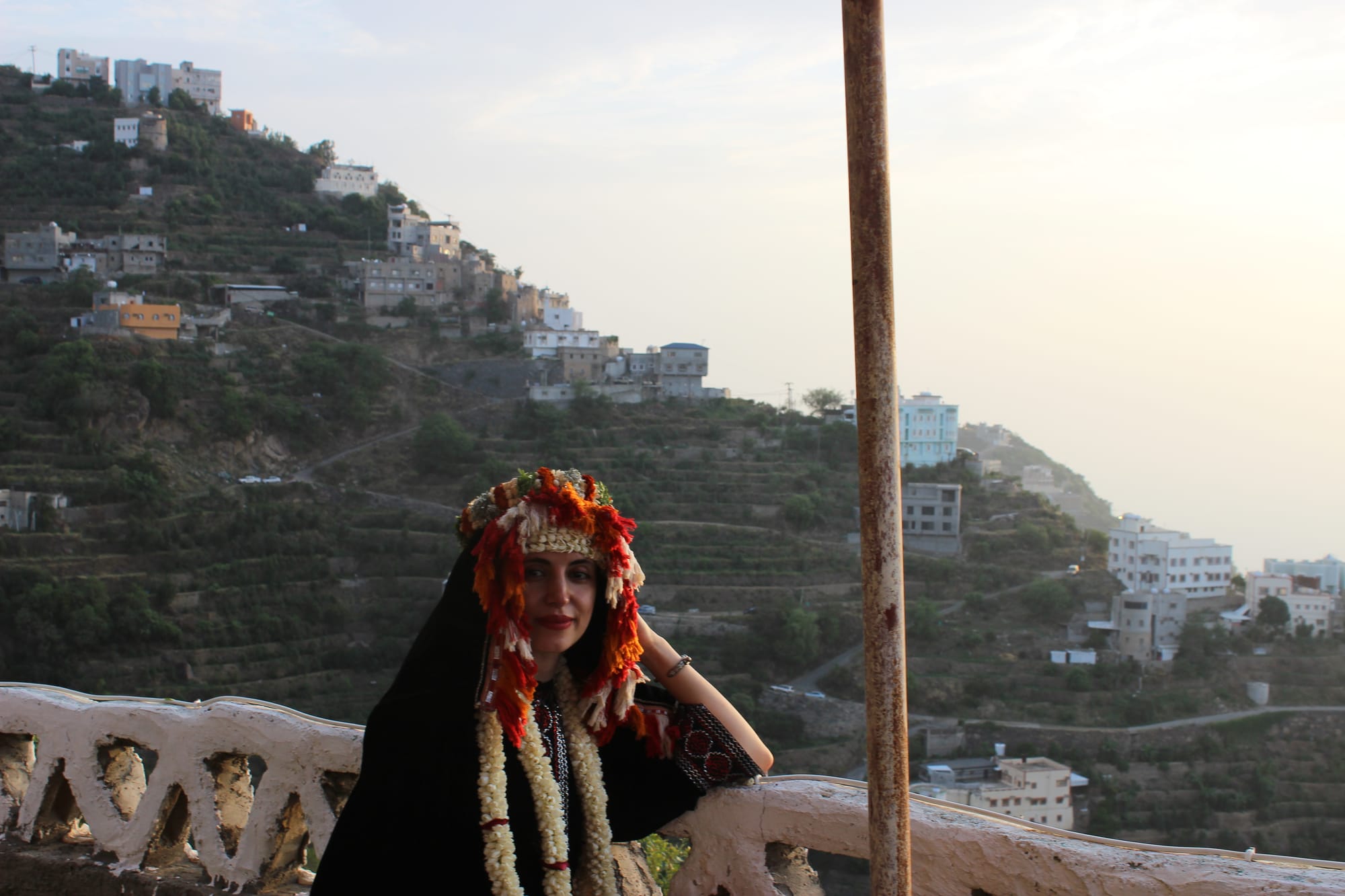
Faifa is said to be home to around twenty tribes, each carrying its own art, poetry, and oral history. What they share is a common vocabulary of dress — distinct for men and women alike, and tied closely to specific materials, occasions, and status.
Men's Attire
|
Term
(English) |
Term
(Arabic) |
Meaning |
|
Shamiz |
شميز |
A white shirt worn by men, also known as faniilah 'askari
(فنيلة عسكري). |
|
Kout |
كوت |
A jacket worn over the shirt. |
|
Misnaf |
مِصْنف |
The wrap or loincloth (izaar) worn on the lower body. |
|
Misbat (belt) |
الحِزباء / المِسْبت |
The belt worn over the misnaf, also known as Al-Hizbaa. |
|
Misbat (bandolier) |
مِسْبَت |
A bullet holder or bandolier worn across the chest or
waist. |
|
Al-Bu'aithran, Al-Kadhi, Al-Khutur |
البعيثران، الكاذي، الخطور |
Aromatic plants worn by the men of the highlands atop the
head, woven into a wreath or garland called 'Akawi (عكاوى). |
Women's Attire and Jewelry
|
Term
(English) |
Term
(Arabic) |
Meaning |
|
Al-Hudwa |
الحضوة |
The decorative trim or embroidery along the edge of a
thobe or shayla. |
|
Thobe |
ثوب |
The traditional long dress, made of silk. |
|
Shayla |
شيلة |
The traditional headscarf. |
|
Mihanah |
مِحَنة |
The Jizani shayla — a headscarf or shawl distinctive to
the Jazan region. |
|
Sadra |
صَدرة / سَدرة |
A velvet top — traditional women's upper-body garment. |
|
Wadah |
وَضَح |
A heavy silver bracelet worn on the wrist or forearm. |
|
Latah (pl. Lawat) |
لَاطّة |
A mid-length beaded necklace weighted at the center by a
silver coin, worn both daily and on special occasions. |
|
A'laj (sing. Alj) |
أَعَلاج |
Silver earrings linked together with beads, put on before
the mendil or mihanah headscarf. |
|
Mesak (sing. Meskah) |
مِــسَك |
Bracelets made of solid silver nuggets. |
Stone and Wood: Architecture and Tools of Daily Life
The same attentiveness to craft carries into Faifa's houses and farms, where local terms describe details of construction and cultivation found nowhere else.
|
Term
(English) |
Term
(Arabic) |
Meaning |
|
Taklin |
تكلين |
The collective geometric decoration spanning two or more
windows, carved from local marw stone. |
|
Am-Garw |
امقرو |
The single geometric decoration above one window, also
made of marw stone. (The prefix am, ام, functions as the definite article,
equivalent to al, ال.) |
|
Am-Shariq |
ام شارق |
A slightly protruding architectural feature built above a
doorway, longer than the door is wide. |
|
Mighlaqah |
مِغْلَقة |
A latch or bolt fitted behind the door, opened only with a
large, old-style iron key. |
|
Mihrath |
مِحراث |
A traditional plow of wood and iron, drawn by an ox to
work the farmland (bilad). |
Souk Al-Nafia'a: The Monday Market of the Mountain
Long before it became the weekly market known today, Faifa's souk began life as Al-Rafia'a, on Jabal Al-Abdali — a mountain whose range extends north to the Al-Jori valley and south to the Al-Thabob valley, and whose peak, standing some 1,500 meters above sea level, lends the market its original name. In the first half of the 12th century AH, the market moved to Nafia'a, on Jabal Al-Mughamer, where it was established by Sheikh Al-Huzami bin Mahdi الشيخ الحزامي بن مهدي and others alongside him. From there it grew into Faifa's weekly souk, still held every Monday.
Episode 3: Souk Al Nafia'a, Fayfa
The souk, too, has its own vocabulary — objects and fixtures that speak to how trade, ceremony, and daily life once came together in one place.
|
Term
(English) |
Term
(Arabic) |
Meaning |
|
Al-Mihjam |
المِهْجَم |
A raised platform, about four meters high, from which a
sheikh or tribal leader would address the people or make announcements. |
|
Al-Muhiz |
المُوحِز |
A large, two-piece mortar used for crushing and grinding
seeds and grains. |
|
Ka'ada |
كَـعدة |
A wooden container for ghee, honey, and other liquid
foods, traditionally used in ceremonies. |
|
Wa-da'a |
وَدع |
An ornamental trim of seashells, used to dress the rim of
the Ka'ada when serving honey or ghee (samn). |
|
Jona'a |
جُونة |
A basket woven from palm fronds, made in sizes ranging
from small to large. |
|
Mihjan (pl. Mahajin) |
مِهجن/ مَهَاجن |
A mat made of palm fronds used as a surface for grinding
grain, and sometimes used as a mat to eat on. |
|
Janbiah (pl. Janabi) |
جَنْـبِيّة/ جنابي |
A long ceremonial dagger worn at the waist by men. |
|
Jaufiyah (pl. Jawafi) |
جوفية/ جوافي |
A shorter ceremonial dagger worn at the waist by men. |
|
Jibnah
|
جِبْنَة |
A clay/pottery vessel used for coffee or tea, heated over
charcoal. |
Souk Sabya, Jazan
According to Lisān al-ʿArab, majāzah (مجازة) denotes a path that cuts across from one side to another, while majāzah (مجازة) refers to a path traversing a salt flat (sabkhah); jīzah (جيزة), meanwhile, is defined as a side or section of a valley (or similar landform), with its plural being jīz (جيز). It thus becomes evident that "Jazan" was not originally a proper noun designating a specific settlement, but rather a general term associated with travel and journeying through the region known in pre-Islamic times as Mikhlāf Ḥakam (مخلاف حكم).
The region later became known as al-Mikhlāf al-Sulaymānī (المخلاف السليماني), named after Sulaymān bin Ṭarf al-Ḥakamī (سليمان بن طرف الحكمي) — a term denoting both the historical and geographical identity of the area. It extended from al-Sharjah (الشرجة) in the south to Ḥalī Ibn Yaʿqūb (حلي ابن يعقوب) in the north, deriving its name from the same Sulaymān bin Ṭarf al-Ḥakamī, who established the mikhlāf (district) as an entity independent of the neighboring states. Within this territory lies the city of Sabya, located about 30 km south of Jazan city.
Episode 4: Souk Sabya, Jazan
|
Term
(English) |
Term
(Arabic) |
Meaning |
|
Adhiyyah
|
عَضيّة |
A band or garland worn around the head, made from Jizani
jasmine (a fragrant jasmine variety from the Jazan region of Saudi Arabia). |
|
Kabbashah |
كباشة |
The craft of making jasmine garlands/necklaces — the term
refers to the craft itself. |
|
Kabsh
|
كَبش |
A necklace/garland made of jasmine. |
|
Rasas |
رَصاص |
Layers of the band of the adhiyyah (head garland). |
|
Misar |
مِصَر |
The Jizani kerchief/scarf worn underneath the shaylah or mihannah |
|
Ji'bah
|
جِعْبَة |
Jasmine (the flower itself). |
Neighbor of the Moon, Still
Seen from below, Faifa looks like one mountain. Walk it, and it reveals itself as many — folded peaks, hidden terraces, a market town that has moved twice in its history and a museum built to make sure none of it is forgotten. Between Al-Kabsi's ten-day land, Philby's twenty-five pages on Jizan, and Am Hussein's blessing at the door of his home, the mountain's story has been told by strangers and by its own people alike. It remains, in every sense the old names intended, a neighbor worth knowing.
Sources
1. Al-Kabsi, Muhammad bin Ismail. (1308 AH / 1890 CE). The Splendid Subtleties Regarding the Chronicles of the Yemeni Kingdom [اللطائف السّنية في أخبار الممالك اليمنية] (Manuscript), p. 84.
2. Al-Tarish Al-Faifi, Ali bin Gasim. (1446 AH / 2025 CE). Faifa Between Yesterday and Today [فيـفاء بين الأمس واليوم]. Edited by Abdullah bin Ali bin Gasim Al-Tarish Al-Faifi.
3. Philby, H. St J. B. (1952). Arabian Highlands. Cornell University Press (published for the Middle East Institute).
4. Philby, H. St J. B. (2005). Arabian Highlands [مرتفعات الجزيرة العربية] (Vols. 1–2) (H. M. Hasan, Trans.; G. A. Juraith, Ed.). Riyadh: Obeikan Publishing.
5. Jezanyat [@jezanyat]. (2023). [Post]. X. https://x.com/jezanyat/status/1726518797136179226
- Encyclopedia of the Kingdom of Saudi Arabia: Jazan Region. Volume 11. King Abdulaziz Public Library. In the year 1428 AH/ 2008 AD.

Further Reading
8. “Fayfa Mountains.” Wikipedia. https://en.wikipedia.org/wiki/Fayfa_Mountains — source for the range's total area and its estimated twenty resident tribes.
9. “Discover Saudi Arabia's Faifa Mountains, Also Known As The Hanging Gardens.” About Her. https://www.abouther.com/node/32331/lifestyle/travel-food/discover-saudi-arabia%E2%80%99s-faifa-mountains-also-known-hanging-gardens — source for the “Hanging Gardens” nickname and the distance to the Red Sea.
10. “Jebel Fayfa.” Saudi Arabia Tourism Guide. https://www.saudiarabiatourismguide.com/jebel-fayfa/ — additional corroboration of the distance to the Red Sea and the mountain's nicknames.
- "Fifa Mountains". Saudipedia, 2021, https://saudipedia.com/en/fifa-mountains. Accessed 16 Sept, 2026.