A few weeks ago, a TikTok made me stop scrolling and think again about a word we use too easily when we travel: culture. A British couple were filming themselves in a drive-through block in Riyadh, surrounded by familiar international brands. What they had hoped to find, they said, was “possibly some culture.”
“So we turned up in Saudi Arabia. I don’t really know what we were expecting, but possibly some culture. And what we found is America…”
Video by Saudi content creator Joud Al-Bader, included with her permission.
Saudi creator Joud Al-Bader responded in the register the platform understands well: humour. With exaggerated sympathy and a British accent, she apologised for their disappointment. Perhaps, she teased, they had expected camels, tents and carpets, something more exotic. Then she offered a decidedly less exotic solution:
“You could probably use Google Maps to… Google some Saudi cuisine restaurants.”
She also pointed them towards other possibilities: Saudi restaurants, local recommendations, tour guides and hiking in the desert, before wishing them a good stay. The exchange is easy to read as a clash. I find it more interesting as an act of intercultural interpretation: two readings of the same place meeting in public. What do we expect culture to look like when we travel?
When Familiarity Is Not Emptiness
There is nothing unusual about travelling in search of local food, architecture, heritage or ways of life different from our own. But the couple’s comment seemed to connect culture with something more visibly distinctive from what they already knew. The place in front of them offered familiarity instead. Travellers rarely arrive empty-handed. We carry images gathered from films, social media, tourism campaigns, news and other travellers. Then we compare the place in front of us with the place we had imagined.
A historic neighbourhood, a market or a heritage village offers one visual language. A contemporary commercial strip offers another. Saudi Arabia contains both.
The drive-through and the old souq are not rivals. They are different rooms in the same house.
This tension between familiarity and authenticity is not unique to Saudi Arabia. Tourism researchers Hanaa Osman, Nick Johns and Peter Lugosi offer an interesting parallel. Studying travellers’ discussions of McDonald’s abroad, they found that global branded spaces can become part of how tourists experience a destination and negotiate ideas of authenticity. A familiar restaurant, in other words, does not simply sit outside the travel experience; it becomes part of how travellers make sense of where they are.
That raises a useful question here: what happens when the culture we encounter does not look like the culture we expected? A coffee shop in Riyadh may resemble one elsewhere. The life around it, does not. Language, humour, hospitality, family habits and the pace of an ordinary evening travel less easily than a logo. The sign can be global. The meaning stays local.
When the Gaze Is Returned
This is where Joud’s response becomes especially interesting from an intercultural perspective. She does not simply tell the visitors that they are wrong. Instead, she takes their interpretation and exaggerates what might sit behind it: camels, tents, carpets and the “bizarre,” “weird,” “dangerous” and “exotic” experience they might have expected. In doing so, she turns the direction of observation around.
Tourism scholar Darya Maoz uses the term mutual gaze to describe something easily forgotten in travel: tourists observe local people and places, but local people also observe and interpret tourists. Each side can arrive with images of the other, and those images help shape the encounter.
Social media gives that mutual gaze a new stage. The visitors pointed a camera at Saudi Arabia and interpreted what they saw. Joud, in turn, interpreted their interpretation. That reversal is what makes the exchange more than a disagreement about a drive-through. The couple saw a street that did not match what they had expected to find. Joud responded by pushing one possible version of that expectation to its comic extreme. She did not simply defend Saudi culture. She made the expectation itself visible.
From Surprise to Curiosity
There is always a temptation in intercultural encounters to decide who misunderstood whom. But misunderstanding does not necessarily mean hostility. Sometimes it simply means that two people are using different frames to make sense of the same thing. Why did this block look like “America” to the visitors? What did they expect Saudi Arabia to look like? And what did a Saudi viewer hear in that pause before the word culture?
Those questions are more interesting to me than deciding whether the original comment was right or wrong. The task is not to pretend we arrive without assumptions. It is to notice them soon enough to look again. That changes the question from:
“Where is the culture?” to “What am I not seeing yet?”.
And Then They Replied
The exchange itself softened. The original creators later described their comment as British humour and made clear that they had actually had a great time in the Kingdom.
“We actually had a great time!”
Joud replied:
“GLAD YOU DID!”
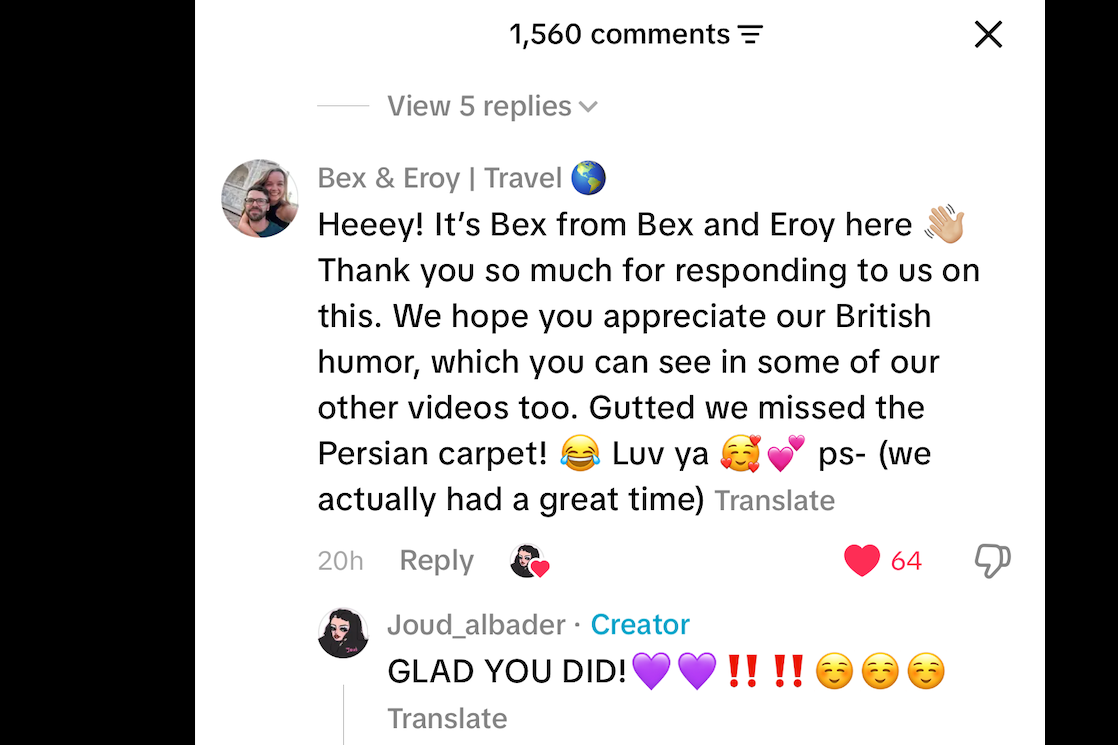
I like that ending. A moment that could easily have remained a clash of assumptions instead became an exchange. Slightly awkward, humorous, and ultimately human. Perhaps intercultural understanding does not require us to see the world in exactly the same way. It may begin simply with recognising that we do not. The travellers continued the exchange in the comments and made clear that they had enjoyed their time in Saudi Arabia. Joud responded warmly.
I like that ending. Neither side had to settle the question of what the original joke “really” meant. Instead, humour left enough room for different interpretations to coexist. Perhaps that is the more useful intercultural lesson.
Travel does not only show us another place. It can also reveal the pictures we carried there with us. Sometimes the street confirms them. Sometimes it gives us a coffee shop and a drive-through instead.
We do not always need to see the same street in the same way. Sometimes we simply need to notice that we are looking at it through different frames.