Souk Athulatha’a is one of the oldest traditional markets in Saudi Arabia, located in Asir, with a history dating back to 1826 CE (1242 AH) (Alneami, 1999). Originally, it was known as Souk Thalooth Ibin Madhan. The word Thalooth refers to Tuesday, the day on which the market was traditionally held, while Ibin Madhan refers to the tribe responsible for the market's security and organization.
The Ibin Madhan tribe played a central role in managing the market, overseeing its security, administration, and overall operation. As the custodians of the market, they were granted the authority to select the day on which it would be held, and they chose Tuesday. In the local Asiri dialect, Tuesday is pronounced Thalooth [θɑluːθ], whereas in Modern Standard Arabic (MSA) it is pronounced Athulatha’a [əθʊlɑːθaːʔ]. Consequently, the market has been known by two names: the earlier Souk Thalooth and the later Souk Athulatha’a (Alhaider, 2024; Alhamed, 2005; Alneami, 1999). Both names remain in use today.
Historically, markets throughout the Asir region were commonly named after the day of the week on which they were held and the tribe or locality associated with them. Examples include Sabet (Saturday) Bani Rezam, Ahad (Sunday) Rufaidha, Ithnain (Monday) Bin Hamoodh, Thalooth (Tuesday) Ibin Madhan in Abha, Raboo’a (Wednesday) Alyazeed, and Souk Alkhamis (Thursday). No market was traditionally held on Fridays. These names reflected both the Arabic weekday and the location or tribe responsible for organizing and protecting each market.
The traditional souks of Asir served purposes far beyond commerce. While they functioned as centers for buying and selling goods, they were also important social, political, and judicial institutions. They provided a venue for settling disputes, resolving financial matters, delivering religious guidance, reciting poetry in praise or satire of tribes, negotiating alliances, praying for rain, and discussing issues affecting the wider community.
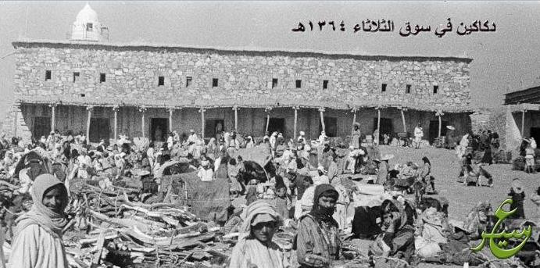
During an interview, Nayazi (2016) described Souk Athulatha’a as:
A weekly event that not only cares about selling and buying but also about the social matters that are essential. For example, reconciliation and the affairs of the Souk that take place every Tuesday.
He further explained that each tribe was responsible for the market established on its land and that the tribal chief, or Shaikh, supervised all aspects of the market's activities. Souk Athulatha’a was also known as Al-Wa'd (الوعد), meaning "the promise" or "the appointed gathering," referring to the regular weekly assembly of tribes from across the region. These gatherings provided opportunities to exchange news, strengthen social ties, and meet members of other tribes (Alhamed, 2005; Mutaen, 2016).
The souks of Asir also reflected the political realities of their time. They served as public forums where tribal leaders discussed regional affairs, including resistance to Ottoman rule. When a tribe required additional support in times of conflict, its representatives would seek assistance from other tribal leaders during the weekly market gatherings.
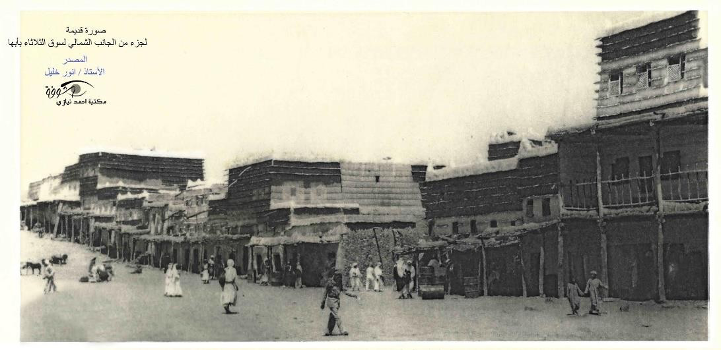
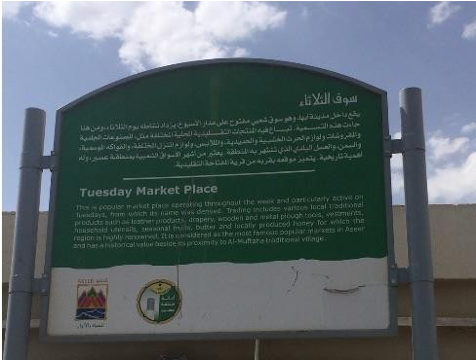
A) A mid-20th-century photograph of the north side of Souk Athulatha’a in Abha. Photo courtesy of Ahmed Nayazi’s Library; photographed by Anwar Khalil. B) The front sign of Souk Athulatha’a in Abha.
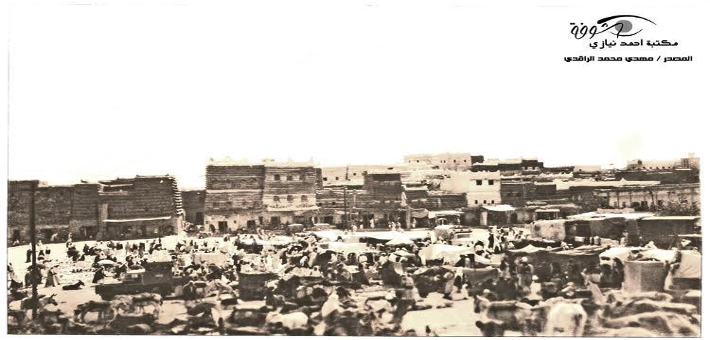
Today, Souk Athulatha’a remains an enduring symbol of Asiri heritage and cultural identity. Although it continues to function as a commercial marketplace where bargaining remains an essential feature of trade, it has retained much of its traditional character despite the rapid urbanization of the surrounding region. The market and its surrounding neighborhood preserve many examples of distinctive Asiri architecture, making the area an important cultural and historical landmark. Figures in this post illustrate both the historical layout of the market and the unique architectural style that continues to characterize parts of the Asir region.
Resources
Alhaider, S. (2024). “Between Souks and Malls: A Semiotic Reading of theLinguistic Landscape of Saudi Arabia”. Publisher Europe Books. https://www.europebookstore.com/products/between-souks-and-malls-dr-siham-alhaider
Alhamed, A. (2005). Customs, traditions and conventions in Asir province (A parallel documentary study). Publications of Abha literary club.
Alneami, H. (1999). The history of Asir in past and present. King Fahad national library publisher.
Personal communication through an interview on Souk Athulatha’a (June 16, 2016) with Ahmed Mutaen.
Personal communication through an interview on Souk Athulatha’a (June 21, 2016) with Ahmed Nayazi.